
Event photographers can work under any conditions—in the rain, in the snow, in low light, even on the floor. That’s part of the job. We deliver. Always.
But there’s a difference between “it works” and “it works well.”
This article describes what event organizers can do to ensure that the resulting photos are not just usable, but truly great. This is not meant as criticism, but as an invitation.
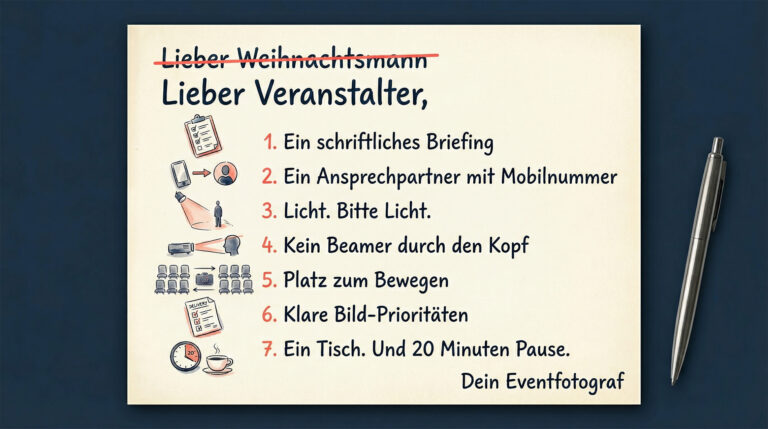
1. A complete briefing. Please provide it in writing.
Not just a couple of sentences on WhatsApp the night before. But a written document with a schedule, key milestones, and points of contact.
The schedule does not need to include the entire program with 200 items. Instead, it should list the items that are relevant for photography: When does the keynote speech begin? When is the panel discussion? When does the board of directors take the stage?
This is especially important: surprises. If there’s a planned surprise, the photographer needs to know about it. Of course, this will remain confidential. But if I don’t know that a special moment is planned for 3:30 p.m., I might be standing at the other end of the hall at that very moment. And the moment will be gone.
A briefing saves time. And it makes the difference between random shots and carefully composed images.
2. A dedicated contact person. With a cell phone number.
Questions come up during an event. Where is the CEO right now? When exactly does the speech start? Can I go on stage?
For that, I need someone who’s reachable—right away—by cell phone.
Not through a corporate headquarters. Not through a hotline with an automated voice system. But through a real person who knows the process and can provide an answer in 30 seconds.
That sounds obvious. In practice, however, it’s surprisingly often missing.
3. Light. The underrated topic.
Light is the most important thing in photography. I can only photograph what is illuminated. That sounds obvious. But in practice, here’s what happens:
The room goes dark. The event begins, the lights in the hall go out, and a single spotlight shines on the stage. It looks atmospheric. But it’s a problem for taking photos, because everything outside the spotlight disappears into darkness.
Speakers step out of the way of the light. The stage lighting is bright and warm. This can sometimes be uncomfortable for speakers. So they take a step to the side—out of the light and into the shadows. That’s understandable. But it makes it impossible to take photos. A quick reminder to the speakers before their presentation solves the problem: Please stay in the light. Twenty minutes on stage. That’s doable.
Two speakers, two lighting zones. When two people are on stage, one is often in the spotlight and the other in the shadows. In the photo, it looks as if one person is more important than the other.
Here’s a simple tip that organizers of political events know: colorful crosses on the floor. Markings that show where people should stand. That way, speakers always know where to stand—and where they’ll be well lit.
Projectors and LED screens. Two common problems. First: The projector is positioned so that the image passes through the speaker’s head. Speakers are rarely taller than two meters. This can be tested and adjusted in advance.
Second: Large LED screens behind the stage. They’re backlit, but no light comes from the front. I can only photograph the light that hits the speaker—not the light shining behind him. The result: a dark silhouette against a glowing wall. By the way, this is also tiring for the audience.
Consult with the lighting technicians. Lighting technicians often hear speakers say, “It’s too bright for me.” That’s understandable. But if the visuals are important, it’s worth finding a compromise. This can be worked out in advance.
4. Freedom of movement and sightlines.
Good event photos are taken from different angles. To do that, I need to be able to move around the room.
If the seating extends all the way to the walls, I have two options: right up front or all the way in the back. Two perspectives. For the entire event.
Just as important: unobstructed lines of sight. A large floral arrangement between the camera and the lectern looks beautiful on the table. In the photos, however, it gets in the way.
Something people often don’t check: the background. At press conferences or CEO appearances, there’s often a green emergency exit sign behind the speaker. You might not notice it in a single photo. But when that image appears in the press, it won’t look the way you imagined. You can plan your visual lines of sight. It’s worth the effort.
5. Clear priorities for image delivery.
“We need the photos quickly” is not a priority. A priority is: “We need three photos of the keynote speaker by 6 p.m. for the press release. The rest by Friday.”
The more clearly you explain what you need first, what you’ll use it for, and the scope you expect, the faster and more accurately I can deliver.
If you need photos for social media during the event, please mention that in the briefing. I’ll make sure to plan for it.
6. A workspace. With electricity.
If you expect to receive photos during the event, I’ll need a place to edit them. No office is necessary—just a small table with a chair and an outlet will do. Ideally, it should be placed where guests won’t be using it.
I’ve edited photos while standing, lying down, and even while driving. It works. But it’s better at a table. And faster.
7. A break.
At all-day events, I’m often on the job from early in the morning until late at night. In between, requests come in: group photos during the break, then portraits, then close-ups of the buffet.
Even photographers need 20 minutes to eat something at some point.
It doesn’t take much effort. All you need to do is schedule a short break into the schedule. When you’re well-rested, you work better. This applies to speakers, event organizers, and photographers.
Better preparation. Better photos.
None of these tips are complicated. Most of them don’t cost anything. And they all have the same result: better photos. For you.
Not because it’s supposed to be more convenient. But because good conditions lead to good results. By design. Not by chance.
If you have any questions or would like to work with me to plan your next event, please feel free to contact me.